Blog
Customer Meeting 2026 roundup
Oct 20, 2026
At this year's Datapharm Customer Meeting, industry bodies, pharma, healthcare professionals and patient representatives came together around one question: how do we keep medicines information trustworthy when mistrust is rising and AI is changing how people find answers?

Datapharm Customer Meeting 2026, No. 11 Cavendish Square, London, 7th October 2026
As the way people search for medicines and health information changes, CEO Rob Morgan set out our collective challenge and responsibility to ensure accurate, regulated content is readily surfaced.
Every professional in this industry has a responsibility to make information easy to find, easy to understand and easy to trust. Verified sources are still where HCPs go – emc benefits from around 20 times the reach of traditional manufacturer sites – and this is playing a critical role in Datapharm’s strategy. Rob was also delighted to announce the new Datapharm Advisory Board, a new body of some of the industry's leading professionals in healthcare and pharma, to give us a new lens on our strategy and how innovation can best serve you, our customers and your customers in healthcare.
Lessons from the day: What the speakers said
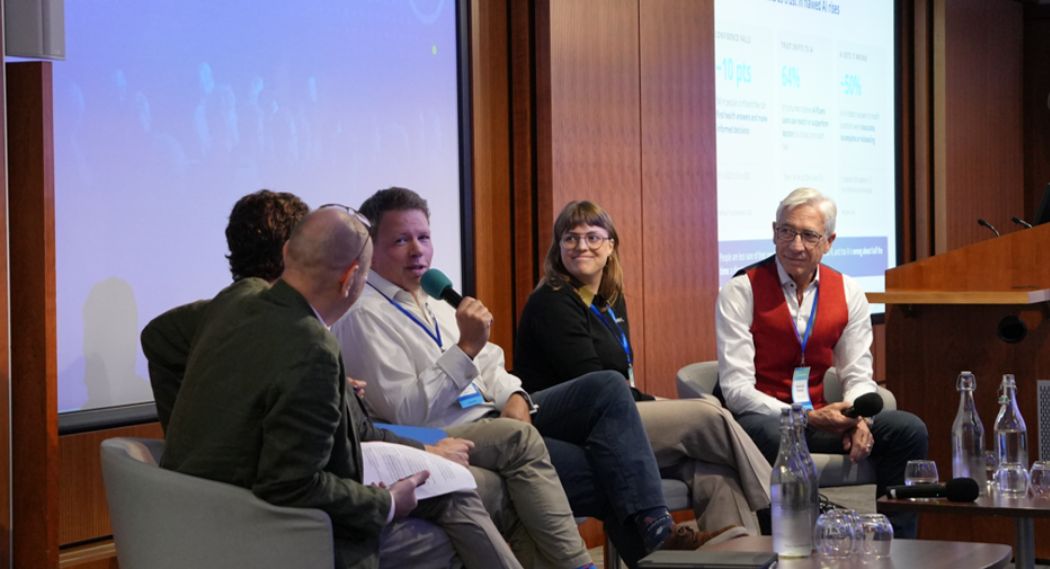
The trust gap is real
The morning panel, moderated by Datapharm's Chief Technology and Innovation Officer, Wayne Enis, opened with two statistics: 64% of consumers believe AI can outperform doctors, yet AI gets medical answers wrong around half the time. Danie du Plessis (WHYZE Health), Ed Greig (Deloitte Digital), Tom Keith-Welsh (Endava) and Laura Zindler (AVAYL) explored how pharma, regulators and technology companies should respond.
The panel was clear on what needs to be true in the next 12 months: a human expert always in the loop, sources given automatically so people can judge answers for themselves, everyone in the space taking responsibility, and an end to the silos between regulators and industry.
Trusted amongst the noise
New research from the 2026 emc user survey, presented by Product Manager for emc, Tara Protheroe and User Research Lead, Justine La, showed where healthcare professionals place their trust. 77% of HCPs rank emc among their top three sources of medicines information, 88% trust it to provide reliable information, and 80% now use it to inform a prescribing or dispensing decision, up from 71% the previous year.
The research also reinforced the AI trust gap. Only 14% of HCPs use AI daily for medicines information, while patients are twice as likely to use it frequently and trust it. HCPs are accountable for their decisions and must question their sources; patients facing long waits are drawn to answers that are instant and jargon-free.
Tara concluded the presentation, emphasising: “We want to bring trusted sources together to make emc even more useful. But we need to make sure that we do so in a way that's responsible, doesn't add friction, and add what's earned its place.”
Meeting AI where it already is
AI tools already treat emc as a source of truth. Datapharm's Head of R&D, Alan Henderson, revealed that AI assistants, at peak, made around 2.6 million weekly on-demand requests to emc, with 40% of the emc catalogue fetched each month. He shared how Datapharm is moving from content as files to content as a governed live service, so that AI answers can be traced back to approved emc content for a specific medicine, and demonstrated an early prototype of an emc assistant for healthcare professionals.
The PMCPA: A more proactive regulator
In the keynote, Owen Robinson, Director of the PMCPA, described the organisation's transition to a more proactive regulator, rather than just reacting and issuing rulings on cases. The Panel has grown from five to twelve members, the backlog has largely cleared, and average case duration has fallen from around 60 weeks to around 35. Owen also covered new social media and package deals guidance (with an amnesty to June 2027), the PMCPA's principles-based approach to AI and plans for a PMCPA-led Code update in the future.
Considering the patient’s journey
Nishali Patel, Clinical Lead at NHS England, showed how the NHS App is changing how patients manage their medicines, with almost 8 million repeat prescription requests a month. A simple design change explaining why some medicines cannot be requested cut practice queries by around a third, but she was candid about the patient journey and the challenges of adherence.
That theme continued in the afternoon panel on closing the content gap, chaired by Datapharm's Product and Data Quality Manager, Sadiya Motorwala. Iram (Mediciens Advice Pharmacist, Specialist Pharmacy Service) captured the frontline pressure HCPs are under to meet patient demand, while Hannah Hunter (ProPharma) emphasised the fact that Pharma is restricted by regulation and using only what’s on the product labelling. Mark, a patient advocate and member of Datapharm's new advisory board, urged the sector to consider a mindset shift to be more people-focussed, while Professor Sam Salek (University of Hertfordshire) argued that patient-reported outcomes are still not standard care.
Trust starts at submission
Trust is built long before information reaches an HCP or patient. Sadiya Motorwala showed how every SmPC and PIL passes through six checks before appearing on emc, including a character-level comparison. Hidden formatting can change meaning: a soft hyphen could turn ‘take 1-2 tablets every 4-6 hours’ into ‘take 12 tablets every 46 hours’. "It might look right when you look at it," she said, "but what's going on behind it? How is it built?"
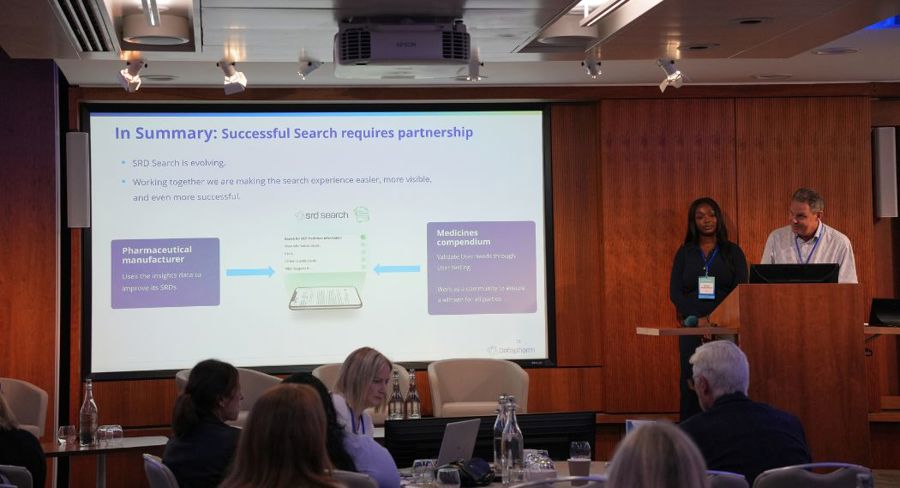
Customers shared what using trusted sources looks like in practice. Aishat Animashaun of Gilead, presenting with Datapharm's Solutions Director, Ian Hamilton, explained how Gilead lifted its Scientific Response Document (SRD) search success rate from 9% to 67% in a year by closing content gaps and widening keywords. Priya Patel and Jessica Quilter of Johnson & Johnson then described moving their full portfolio to emc pi portal, making PI management "almost invisible". Their advice: start with a pilot, and remember that successful change means involving all the internal stakeholders who work with PI.
Building what comes next, together
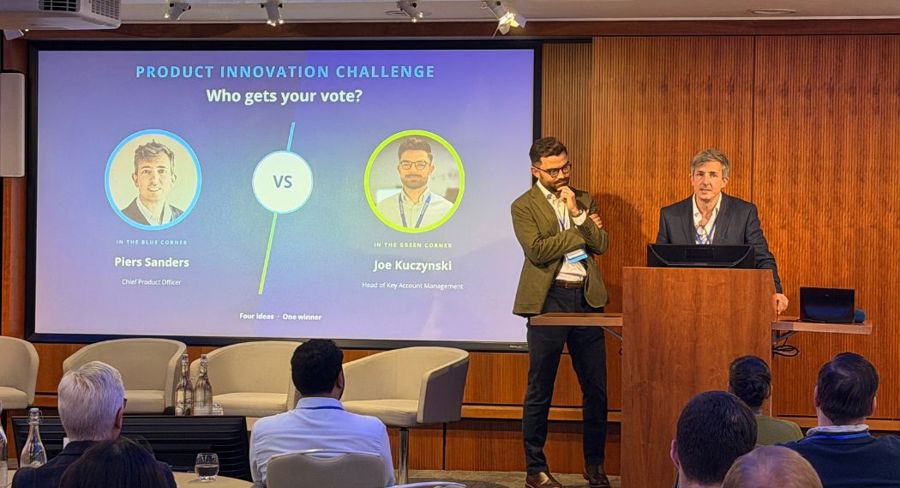
In the product innovation challenge, Chief Product Officer, Piers Sanders, and Head of Key Account Management, Joe Kuczynski, put four early-stage ideas to an audience vote, from digital dissemination of additional Risk Minimisation Materials (aRMMs) with proof of receipt, to an AI tool that answers only from approved content. The aRMM idea narrowly came out on top. "We only want to build products and ideas which are going to solve your problems," said Joe, and Datapharm committed to co-developing any idea that progresses with at least one pharma company. As Piers put it: "You never build something unless you're building it with someone."
Find it, understand it, trust it
Over the course of the day, one message came through consistently - accurate information exists, but it is competing with answers that are faster, more confident and often wrong. Instilling trust in verified sources has never mattered more, and keeping them visible, usable and trusted will mean regulators, the NHS, industry, patients and Datapharm working together more cohesively than ever.
Work with us to create future medicines information solutions
Thank you to all our speakers, panellists and attendees for creating a special day, and we look forward to seeing you at next year’s event. If you would be interested in co-developing any of the above product ideas with us, reach out to our team at [email protected].
More photos from the day


