Blog
Does AI have a place in trustworthy medicines information?
Dec 12, 2025
As generative AI technology moves forward at rapid speed, Datapharm looks at one of the ways AI-generated results can provide more trustworthy answers on regulated medicines information.


Simon Zedlewski
Content Marketing Manager, Datapharm
If you ask any prescriber about their work, what stands out is their need to have access to information quickly, at their fingertips. We’ve been given plenty of evidence by HCPs (healthcare professionals) about how time poor they are, and will inevitably hear things like the following:
“Particularly if you’re in a busy clinic, where you’ve got 10-minute appointments and patients are coming and going, you want something that’s not going to slow you down.”
- UK Independent Pharmacist
“If I suddenly have a patient that is asking me about something I completely haven’t prepared, then it will take me the 5 minutes that I don’t have in clinics to find.”
- UK Oncology Pharmacist
“Doctors do not have the time to spend with their patients anymore, very short with doctors here, they just don’t have the time like they use to!”
- Member of the public
So with the wealth of information available to them, under immense time pressure, there is a clear need for HCPs and patients alike to have quicker access to trustworthy, up‑to‑date medicines information.
Generative AI has suddenly empowered us with a great efficiency to answer our questions, but these tools bring both promise and concern. While they can deliver answers at speed (and HCPs are not hesitating so much to use them), questions remain around transparency, explainability, and whether the information it provides can be trusted in regulated and clinical contexts.
So what is the answer?
The wonders of ePI
ePI (electronic Product Information) changes the game on data accuracy. It is healthcare’s answer to structured medicines information that provides the flexibility for this information to be used in accessible formats and be personalised, while also remaining up-to-date.
What is electronic Product Information (ePI)?
Electronic Product Information (ePI) is the regulator‑approved medicines information (such as the Summary of Product Characteristics, patient information leaflet, and/or labelling) published in a structured, digital format. It is adapted for handling in electronic format and dissemination via the web or digital platforms.
The industry is coming up with innovative solutions such as AI agents to provide quicker answers within HCPs’ information-seeking journeys. But the need to solve the issue of data accuracy has, undeniably, never been greater.
In part, ePI provides an answer to this issue. With a structured approach to medicines information, this means it is kept up to date. But it also needs a way of being referenced by the AI agent in a contextually accurate way. Failing to do so, not only means walking a thin line in regards to Code compliance, but most alarmingly risks patient safety where information is factually incorrect.
A method against misinformation: Model Context Protocol
The answer to this context problem lies within something called a MCP (Model Context Protocol). Without going into the technicalities, it enables FHIR structured data in the ePI to be discoverable and usable by AI agents.
Think of it as a kind of wingman for the AI agent and FHIR data to hook up with each other. The AI agent wants an expert opinion from the MCP server before getting information out of the FHIR data – in real terms, it gets the MCP server’s expert, up-to-date view of what’s needed to answer the user’s query.
What this would look like in practice is reliable answers to questions about licensed medicines, where the answers are explainable.
Here’s an example used with a fictitious medicine:
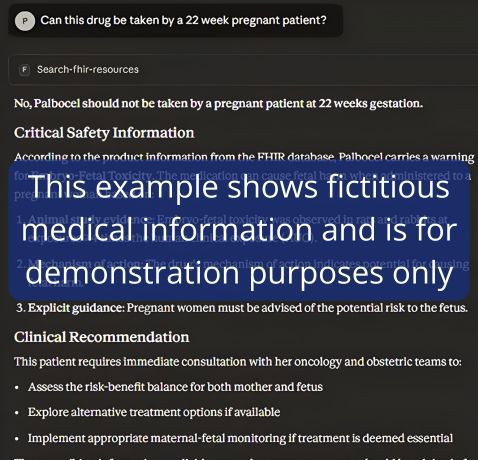
So, in a world of heavily regulated medicines information, is AI able to provide trustworthy answers? In short, it depends. It will need more testing and guard rails, but we can see the potential tech solutions.
Then there are challenges with delivering a solution of this nature. Firstly, there is a lot of data in an ePI such as the above example - there will be a significant amount of work to ensure that every licensed medicine is structured so granularly, and it will need highly qualified clinical data architects to make it happen. The other challenge will be mass collaboration in the industry, and it will take Pharma, Healthcare professionals and regulators together with the right technology partners, to make it happen.
Learn more about AI use in medicines information
Datapharm demonstrated the MCP server as a prototype for AI-generated answers in Gravitate Health’s Open E2E ePI Community Webinar. You can learn more about this topic here:
How do you get reliable answers about medicines information from AI tools?
Datapharm is part of the Gravitate Health project, which holds the mission to empower and equip Europeans with health information for active personal health management and adherence to treatment. The project includes working together to create valid use cases with structured ePIs, based on FHIR (Fast Healthcare Interoperability Resources).
If you would like to discuss how Datapharm can support you with your ePI projects, get in touch with our team at: [email protected]